Plastic Bearings Case Study:
Superior Performance of Plastic Bearings in Volatile Environments
The natural lubricity together with the chemical, corrosion and high temperature resistant properties of thermoplastics whilst remaining abrasively soft, has resulted in a series of precision bearings for use in the manufacture of LCD glass.
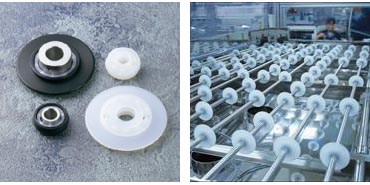
BNL designed a series of plastic bearings for an industry leader in the manufacture of machinery for the production of large LCD flat panels. Machined from Ultra High Molecular Weight PolyEthylene (UHMWPE) and Polyetheretherketone (PEEK) with PolyEthylene (PE) balls, the bearings support the wafer thin and very fragile LCD panels as they pass through various processes on the machines – etching, exfoliation and two types of drying. Conductive versions of the bearings used in areas requiring anti-static/static dissipative properties are also produced using carbon fibre reinforcement. To produce an UHMWPE bearing to the required specification was a challenge for BNL since a bearing made from this material has a tendency to deform after machining.
Each LCD manufacturing process involves the passing of the glass panels through huge tanks containing either chemicals or dryers, straddling which are the bearings mounted on shafts. BNL’s challenge was to choose the most suitable materials for each process, as different environmental conditions had to be considered. During the etching process, for example, the bearings are submerged in chemicals that etch the surface of the panel. As the use of metal parts in this process is inappropriate, thermoplastics are the ideal solution. In the exfoliation process, cleaning agents are used to remove the etching chemicals and any LCD residue. Here the bearings are also exposed to high temperatures and static build up which could potentially cause damage to the glass.
In each process it is essential that the bearings sit level and at the same height to ensure the panel is supported by each one – if an oversize bearing were to be fitted to the shaft, it would locally stress the panel and cause it to crack. A very clean and smooth surface, free from features that may mark or scratch the surface of the panel, is also required and as the glass must be moved very quickly - 250mm per second - a perfectly smooth rotation of the bearing is vital.
Prior to BNL’s involvement in this project, metal bearings were used which had a typical life of only one run before replacement was required due to chemical attack. With the thermoplastic versions, the product is now capable of being used for many runs whilst reducing damage to the LCD panels and minimising the cost of production for what was a consumable part.
View Plastic Bearing Technologies and Applications