Plastic Bearings Case Study:
Plastic Bearings Significantly Improve Performance
A BNL custom-designed plastic bearing resolved distortion and disassembly
problems as well as increasing load bearing capabilities for a mobile satellite
antenna.
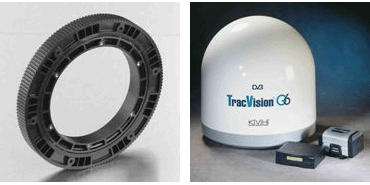
When the world’s leading provider of mobile satellite communications and TV-based antennas began to experience problems when their existing bearing failed to meet the high standards demanded by their products and commissioned BNL to find a new solution. The original bearing was distorting and disassembling in operation, pushing apart at very low loads. It was also complex to create and the high cost due to the machining process was also unsatisfactory. The brief to BNL was to resolve these problems quickly.
The bearing - at 242mm in diameter, one of BNL’s largest regularly manufactured part - is being used in sophisticated satellite TV antenna systems - a land mobile antenna and a marine antenna. Such sensitive state-of-the-art equipment demands a precision bearing that is able to move precisely and accurately in order to maintain a consistent and uninterrupted satellite signal as the vehicle moves.
An azimuth bearing, injection moulded from acetal with stainless steel balls, the BNL solution offers significant improvements over the original bearing’s performance. The re-design of the raceways has increased push apart force by 300 times avoiding disassembly in operation, and the company’s tooling strategy has meant the minimising of machining operations, cutting the
piece part cost by over 25%. The team was also able to integrate additional features such as pads to provide more stability for the end product.
“One of the challenging aspects of this bearing was to manufacture thin section parts with tight tolerances over large dimensions whilst allowing free running and stability” explains BNL’s R&D Manager, Jason Gregory. “The development undertaken at BNL enabled us to add a planar defl ection of the races of 3mm (peak to peak) with little increase in rotational inertia enabling us to be confi dent that the parts could be attached to a non fl at surface without unduly effecting the bearing’s capabilities.”
View Plastic Bearing Technologies and Applications